
If your ALIBARBAR vape feels blocked, has weak airflow or suddenly stops producing vapour, the problem may not be as simple as a blocked mouthpiece.
From looking into common issues with draw-activated vape devices, I've found that airflow complaints generally fall into three categories: physical blockages, moisture-related problems and electronic activation faults.
For ALIBARBAR INGOT 9000 users in Australia, knowing the difference can help you recognise a faulty device without attempting unsafe repairs.
1. Why Is My ALIBARBAR Hard to Draw?
When an ALIBARBAR feels unusually difficult to draw, restricted airflow is one possible explanation.
Common causes include:
Blocked air inlet: Dust, lint or debris may obstruct small external openings.
Condensation buildup: Moisture can collect in narrow airflow passages.
Internal liquid leakage: Escaped liquid may interfere with airflow or sensors.
Manufacturing defects: Misaligned components or internal obstructions may affect airflow resistance.
One detail worth knowing: a tight draw doesn't automatically mean the heating element is damaged. Airflow resistance and heating performance are separate issues.
If the device shows visible leakage or damage, stop using it rather than attempting to force air through it.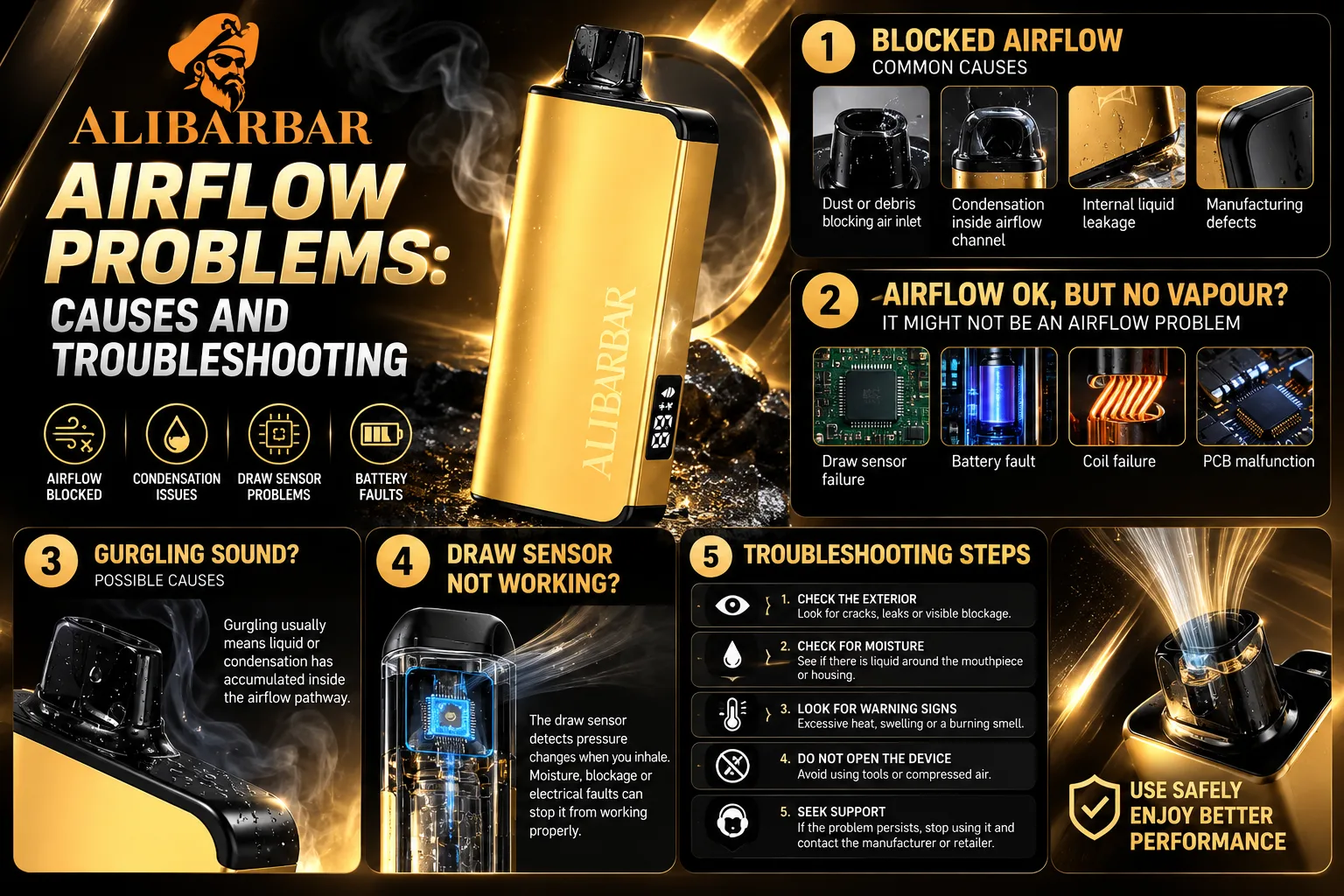
2. ALIBARBAR Has Airflow but No Vapour?
This is where many people misdiagnose the problem.
If air can pass through the device but no vapour appears, the airflow channel may not be the cause.
Possible fault
What happens
Draw sensor failure
Device does not detect inhalation
Battery fault
Insufficient power reaches the heating element
Coil failure
Heating element cannot operate correctly
PCB malfunction
Electronic activation is interrupted
Liquid-delivery problem
Heating element does not receive liquid as intended
My key takeaway: No vapour doesn't necessarily mean blocked airflow. The problem may be electrical rather than mechanical.
3. Why Does My ALIBARBAR Make a Gurgling Sound?
Gurgling often suggests that liquid or condensation has accumulated somewhere along the airflow pathway.
Possible signs include a bubbling noise, moisture near the mouthpiece or inconsistent activation.
Condensation can occur when warm aerosol meets cooler surfaces, but persistent gurgling alongside leakage may indicate a more significant internal fault.
Avoid inserting sharp objects, blowing compressed air into the device or opening the housing. These actions can damage seals, sensors or battery components.
4. ALIBARBAR Draw Sensor Not Working
Many draw-activated vape devices rely on a pressure-sensitive sensor rather than a manual activation button.
When the sensor detects a pressure change, it signals the control circuit to activate the heating element.
Problems may occur when:
Moisture reaches the sensor.
Internal electrical connections become damaged.
The pressure signal is obstructed.
The sensor or control circuit fails.
A defective draw sensor can make an otherwise unobstructed device appear completely unresponsive.
Sensor faults usually cannot be reliably diagnosed or repaired from outside a sealed device.
5. How to Check ALIBARBAR Airflow Problems Safely
Before assuming a particular component has failed, focus on visible symptoms.
Inspect the exterior: Look for cracks, leaks, deformation or visible obstruction around external openings.
Check for moisture: Note any liquid around the mouthpiece or housing seams without opening the device.
Watch for safety warnings: Excessive heat, swelling, smoke or a burning smell may indicate a hazardous electrical or battery fault.
Seek technical support: If the problem persists, discontinue use and contact the manufacturer or an appropriately qualified professional.
Do not dismantle, puncture, heat or modify a sealed device to restore airflow.
6. Could a Fake ALIBARBAR Cause Airflow Problems?
Counterfeit products can introduce uncertainty about component quality, manufacturing consistency and product safety.
However, airflow problems alone are not proof that an ALIBARBAR is counterfeit. Genuine electronic devices can also develop faults.
For authenticity checks, compare the packaging, product identifiers and manufacturer verification information. Be cautious with QR codes that lead to unfamiliar websites, because printed codes can be copied.